Pages

Labels

Friday, August 4, 2006

The Schedule

In an attempt to get more organized (more on that later, if time permits!) Darwin and I sat down last evening and created a little "curriculum" for the girls for fall. It's a simple list of what we want the girls to accomplish. Some of the resources we have, some are ordered, and some we need to find, but I think it's an achievable set of goals.

Noogs (4)

Religion
Writing
Math
  • Basic addition and subtraction
  • Learn to tell time
  • Study the calendar: learn the days of the week, the months, and the seasons
Reading
Personal
  • Make Bed
  • Put dirty clothes in hamper
  • Brush own hair and teeth

Babs (just about 3)

Religion
  • Basic prayers: Our Father, Hail Mary, Glory Be, Grace before meals (she has these pretty much down, but it doesn't hurt to keep working on them)
  • Read Tomie De Paola's Bible Stories out loud.
Writing
  • Memorize alphabet and identify letters
Math
  • Identify numbers
  • Work on counting
Reading
Personal
  • Put dirty clothes in hamper
  • Potty training
  • Brush own teeth
Baby (5 months)
  • Cut that tooth!
Seeing it all written down looks a bit intimidating, frankly. However, I think that these are things we would be working on whether or not I consciously planned them out. And it seems that it can't be too soon to start documenting what we're doing, both for future reference and in case anyone ever wants to give us trouble about homeschooling (God forbid!).

Thursday, August 3, 2006

The Spam Fantastic

I just read yesterday about the phenomenon of "empty" spam: spam that contains large chunks of literature (generally of the 18th-century variety) to slip past filters. Lo and behold, today it happens to me! In a solicitation for Mr. Clean's Magic Erasers, I received the synopsis of what seems to be a blood-and-guts Spanish tragedy. Anyone want to hazard a guess as to what play this could be?
Act I, Scene i Don Andrea, a Spanish courtier, has been killed in battle against the Portuguese. His soul is brought out of oblivion by Revenge to witness the death of his killer, Balthazar, at the hands of his lover, Bel-Imperia. Act I, Scene ii A Spanish General describes the battle, in which the Spaniards were victorious, to the King of Spain. Lorenzo and Horatio bring Balthazar as a captive before the King who says that he shall be treated with honour. There is debate between Lorenzo and Horatio as to who took Balthazar captive. The King decrees that Lorenzo shall have Balthazar's weapons and horse, and that Horatio shall have the ransom. He places Balthazar in Lorenzo's charge. Balthazar asks Horatio to keep him company. Act I, Scene iii The Portuguese Viceroy learns that Balthazar has not been killed in the battle, but taken prisoner. Villuppo claims that Alexandro tried to kill Balthazar which caused the Portuguese rout. The Viceroy has Alexandro led away, while Villuppo hopes to benefit through his deception. Act I, Scene iv Horatio tells Bel-Imperia about Andrea's death. Bel-Imperia transfers her affections to Horatio and have her revenge on Balthazar. Lorenzo and Balthazar come across her. Balthazar is in love with Bel-Imperia and there is witty, but pointed by-play between them. Bel-Imperia drops her glove which is retrieved by Horatio who reports that the King and Portuguese Ambassador are coming. Hieronimo, Horatio's father, arrives with a dumb-show which he explains as England triumphing over Spain. The Ambassador interprets this as a warning to the King for Spain not to be too proud after the victory. Act I, Scene v Andrea complains that all he has seen is Balthazar having a good time. Revenge assures him that it will not last.
...Act IV, Scene i Bel-Imperia claims that Hieronimo is not doing anything to avenge Horatio. He already has a plan in mind. Lorenzo and Balthazar enter. As one of the entertainments for the wedding, Hieronimo intends for them to act in a play about Erasto, the Knight of Rhodes, with each of them taking a part, and each speaking a different language. Act IV, Scene ii A distraught Isabella enters. She kills herself. Act IV, Scene iii A brief scene in which Hieronimo is preparing for the play. Act IV, Scene iv The play is acted before the King and Viceroy. In the guise of the Turkish emperor's lieutenant, Hieronimo stabs Lorenzo who is playing Erasto the Knight of Rhodes. Bel-Imperia, as Perseda, stabs Balthazar (the Turkish emperor) and then herself. Hieronimo reveals the truth and tries to kill himself, but is arrested. The King threatens to torture Hieronimo into telling him who his co-conspirators were, but Hieronimo bites out his own tongue. He then stabs the Duke of Castile and kills himself. Act IV, Scene v Andrea is now satisfied and the dead are all given their just rewards. Lorenzo, Balthazar, Pedringano and Serberine will all be punished suitably, as will the Duke of Castile.

Pretty lurid stuff! An honorable mention goes to the reader who does my Google work for me.

AND the Honorable Mention goes to: both A Philosopher and Bernard Brandt, who inform me that this is none other than Thomas Kyd's A Spanish Tragedy (seems I wasn't far off in my guess!). I've shortened the synopsis accordingly.

Genetic Outlaw

Several people, most recently Kevin Jones of Philokalia Republic, have already linked to this, but I thought this BusinessWeek opinion piece on genetic testing and eugenics by Prof. Elizabeth Schiltz was definately worth quoting:
Scientists are beginning to tell me precisely how much dissident acts like not aborting my son cost society. A study published in 2000 in the American Journal of Medical Genetics concluded that the average lifetime cost of each "new case" of Down syndrome is $451,000. This study differentiated the lifetime costs of various types of prenatally diagnosed disabilities leading to abortions in one hospital in Michigan. For reasons I can't fathom, Down syndrome turns out to be the most expensive by far. In contrast, the lifetime costs of conditions like spina bifida ($294,000) and cleft lip or palate ($101,000) seem almost negligible.

This study was offered to quantify the cost of banning "second trimester elective terminations for prenatally diagnosed abnormalities." Imagine the public outrage that would greet the publication of a study calculating the cost of not terminating pregnancies if it were broken down into a category such as family income. Although most of our civil rights laws now include "disability" in the litany of prohibited bases for discrimination—along with race, gender, and ethnic origin—our enlightened liberal commitment to diversity appears to go only so far. While we are willing to mandate accommodation to make jobs or public transportation accessible to a person with spina bifida, the social cost of accommodating her birth is increasingly being seen as exceeding her worth.

This emerging public consensus in favor of eugenics is not the product of any sort of reasoned debate. There has been no referendum, no debate in Congress, no move to amend the Constitution. It's emerging from the collective force of countless decisions by loving and caring mothers and fathers, in consultation with conscientious medical professionals who are using the truly miraculous and astonishing discoveries of brilliant scientists plunging deeper and deeper into the mysteries of life. These people are not intentionally practicing eugenics in order to create a perfect master race. They are simply trying to alleviate potential suffering and protect the quality of the lives they are bringing into the world.

But it is time for us to acknowledge the collective effect of these private decisions. Do we truly endorse the implicit message we are sending to our disabled brothers and sisters—that our commitment to diversity does not extend to genetic diversity? We need to confront the disconnect between how we see ourselves—as an enlightened, liberal society committed to fully integrating people with disabilities in all sectors of life—and how people living with the disabilities we would identify for extinction must see us.

Issues like this will doubtless come more and more to the fore in the coming decades, both because the improvement of medical technology will make greater 'improvement' of the human race possible, and because these sorts of issues cut to the very center of the issue of what it means to be human.

Wednesday, August 2, 2006

Math Bleg

Several readers commented on how my "What you should know by 18" list was pretty light on the math and science (though I hope some of the addendums in the comments helped with that). One of the issues there is that I had a hard time coming up with a good idea of what the minimum a civilized and functional person should know in these fields would be. It really was meant to be a pretty basic list. (A high school student could do all the reading on that list in under a year, I'm pretty confident.)

The other problem, however, is that although I deal with data analysis on a daily basis as part of my job, I've honestly forgotten most of the higher math I ever knew. I went through calculus in high school (I used the Saxon textbooks and did moderately well) but that's ten years behind me now. On a daily basis, I mostly just end up summing and averaging large record sets. Once in a while I do a little regression analysis: but that's just by using the crutch of trend() and forecast() functions in Excel, not through any solid remembrance of the math involved.

But this is something I've been feeling increasingly guilty about lately. And as my projects seem to get more and more mathematically intensive, one of these days it's going to come back to bite me.

So for those of you with serious mathematical chops: Can anyone recommend a good refresher book on higher math? On a practical level, it wouldn't hurt me to read up more on the kinds of business data analysis that I do on a regular basis, but at a more basic level I feel like I never fully "got" calculus and some of the other elements of higher math, although I gained the ability to get through problem sets with relative facility. I tend to be the sort of person who needs to nail the general theory in order to feel like I really understand what I'm doing at the particular level. So I'm thinking I may need something that takes something of a top-down approach. I still have my high school calculus text book sitting around, but I'm kind of wondering if I need to take a different approach.

Suggestions welcome.

Tuesday, August 1, 2006

Painted Ladies

For them as cares:

1. Two walls of the living room have been painted -- the easy walls. Now for the twelve-foot ladder and the huge heavy overflowing bookcase.

2. The carpet was cleaned this morning. Night and day, folks, night and day. I almost don't hate it.

The before pictures are waiting to be picked up, but the after pictures are going to take a bit longer. But it's quite a difference, believe me!

And that's what I did this summer, teacher.

Bad news for Jack

Please keep eight-year-old Jack in your prayers:
We just received the bad news tonight that Jack's cancer is back. He had a MRI done on Friday because they were concerned because his blood counts were still low.
They are cancelling the bonemarrow transplant because it would be of no use....the chemo they're using is obviously not working. Tomorrow Jay and Suzy will meet with the doctors to see if there are any other options, such as a clinical trial in another city that will accept him.
We obviously need that miracle...
Thank you so much for all of your prayers....it is such a comfort to our family to know that others are out there praying for our Jack.
Once again, here's the prayer for Jack.
Venerable Louis and Zelie Martin, Servants of God,
You offered many prayers for your own sick children.
We unite our prayers with yours for Jack's healing.
May God look favorably on your intercession and, in His Mercy, grant us our request.
May His will be done in all things.

Venerable Louis and Zelie, pray for us!

I'd Like Mine In Green

Much has been said over the last couple weeks in the ranging argument about art and whether it is morally/culturally/aesthetically acceptable to modify it, with the main disputants being Steven of Flos Carmeli, Tom of Disputations and ZippyCatholic.

The 'cultural conversation' side of the argument seems to be of the opinion that editing a work to remove content you object to is morally upright and culturally unproblematic because once an author completes his work, it is the property of the current owner and of society as a whole, rather than the artist. The artist thus, the theory goes, has no particular right to never see his work changed.

My own thinking is that a piece of art represents a crystallization of the artist's thought, and thus of him. And in that sense, while one is certainly welcome to create derivative works which make one's "commentary" on a existing piece of artwork (in the world of music variations on a theme are sometimes more interesting than the original theme), changing or destroying the original piece seems far too grave a step -- erasing, as it does, the distilled piece of thought and personhood which the artist left behind. (Obviously, this all has to do with modifying an original work. Clearly, modifying a copy of the original is of less import to the wider culture, regardless of whether it is morally or aesthetically right in and of itself.)

I wonder, however, how the pro-modification disputant would address the question of a strictly aesthetic desire to modify an original work. Say someone decided that the Venus of Urbino should have a cat next to her instead of a lapdog. Would it be part of the 'cultural conversation' to paint out the dog and replace it with a cat? Certainly, certain people might feel there is a moral imperative to put a stitch or two of clothing on Venus before she gets cold, but would those who support the idea that it would be already to throw a little drapery over her also support changing strictly aesthetic elements of the painting?
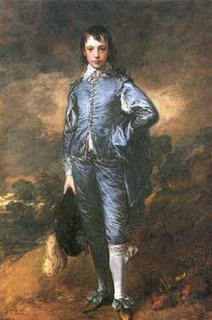
Or say you really felt that Blue Boy should have been Green Boy. Would one be justified in painting over the original. Obviously, one could make a knock-off painting, and some have to varying effect. (Goodness...) But could one modify the original?

And if not, does this not suggest to those who are holding that modifying a work for moral reasons is acceptable that there is some degree of weight to the original creation of the artist, such that even in their own view one must have a sufficiently good reason to change a work of art, beyond mere whim?