Pages

Labels

Showing posts with label humanities program. Show all posts

Sunday, February 6, 2011

Art Updates

During this whole moving process, I've neglected the whole Junior Humanities Program pretty shamefully, although I have been enjoying very much reading Grombrich's A Little History of the World to the kids in the evenings over the last month since we got into the house and started up school again.

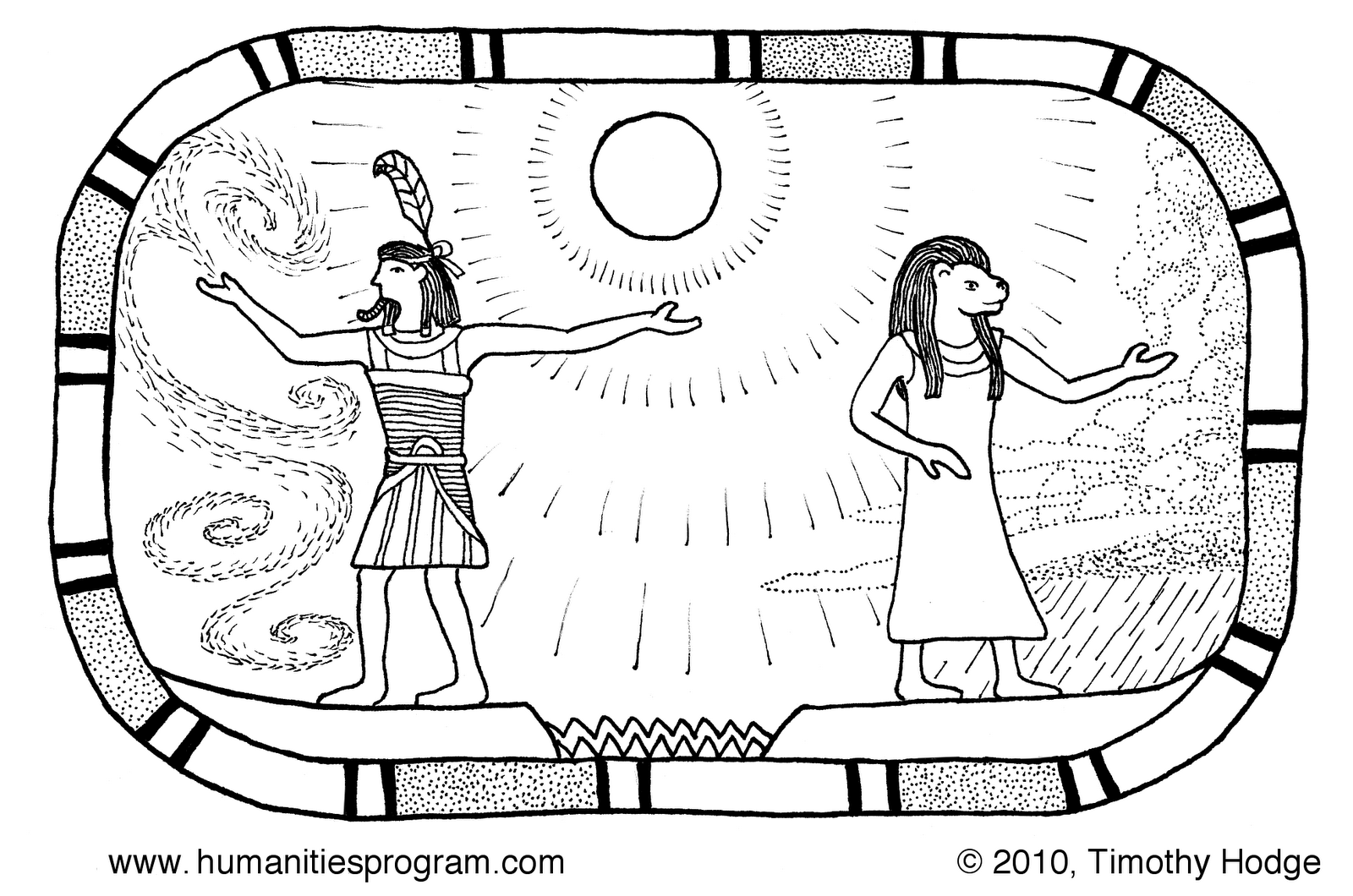
Fortunately, my brother Tim has not been idle, and he's just posted five beautiful illustrations for the Egyptian Mythology story. Here are a couple:


Tim, incidentally, is an all around talented artist. He does the illustrations for the Humanities Program and also has some items up on Zazzle which may appeal to the geeky of heart.


Monday, August 2, 2010

Norse Mythology Comes to the Humanities Program

My little sister spent her wild young days studying Old Norse and Old English at Oxford, before settling down as a mild mannered web-programming lay Dominican, so it was of course irresistible to ask her to tackle Norse Mythology for the elementary Humanities Program (volume two covers the "dark ages"). First up, the Norse creation story:
In the beginning there was Múspell, the realm of fire, and Niflheim [niv-uhl-heym], the realm of ice. Between them there was nothing except a vast emptiness called the Ginnungagap [gin-oong-ga-gahp]. For many ages there was nothing else. But gradually, sparks began to fly out of Múspell while icy fogs billowed out of Niflheim. They met in the middle of Ginnungagap, which became as mild as a summer's day; the fog condensed into water-drops, and the drops were given life by the sparks.

Out of the mixture condensed Ymir [ee-mir], the first giant....
However, you must read the whole thing to find out about the giant who gave birth via his armpits and about the world cow.

Friday, July 9, 2010

One Last Humanities Program Post

I know this is probably only of interest to a subset of readers, and I'll doubtless get busy and move on to other topics soon (I've had the luxury of time over the last week since my mother-in-law has been here to help with Her Tiny Cuteness) but I've just finished putting together rough cuts of the lists for the 3rd and 4th years of the high school level Humanities Program, and I'd like to solicit feedback from them that's interested in such things.

Year Three: From the Rise of Islam to the Protestant Reformation

Year Four: The Modern World

In Year 4 especially I have the feeling that the list is both too long and incomplete, as is perhaps necessary in such an attempt.

The goal here is to lean more towards cultural literacy and having a feel for the flow of history than hitting all the Great Ideas type works, so a lot of the heavy duty philosophy that you'd find in a traditional Great Books list is not here. Suggestions and comments very much welcome.

You are welcome comment there as well as here if that's easier, but if I proceed to make a bunch of changes to the lists I may eventually clear out the comments on the Human. Prog site for the sake of cleanliness and relevance. That, and I'm thinking I need to come up with a more actionable format broken into weeks, not to mention links to editions and brief framing commentary on some of the works.

Thursday, July 8, 2010

Religious History Bleg

One of my goals over this baby-cation is to revise and post at least rough reading lists for years 3 and 4 of the High School Humanities Program. I'm working off the three versions that each of us kids in my family used (Dad would revise the reading list each time, trying to fit everything in) and trying to trim to down to a reasonable length and deal with the occasional blind spots and ommissions.

One of the main areas where I'd like to add or change selections is in Year 3, which is supposed to cover from Muhammad to the Protestant Reformation. We tried various attempts at covering the rise of Islam, from the basic (reading the Catholic Encyclopedia and Britanica articles on Islam and Muhammad) to actual primary source (reading the first three books of the Koran: Al-Baqarah, Al-Imran and Al-Nisa). I'm not really sure what the right approach is here, especially as Islam is much more talked about now than it was in the mid 90s, and so a student is likely to be coming to the program with a certain amount of perception already in place. I've got 1-2 weeks of a bright high schoolers history/literature reading time available -- perhaps 100-200 pages depending on the difficulty of a source. What suggestions do people have as to the best intro to Islam and/or Muhammad? I've got separate selections for covering the Crusades, etc. Here we're pretty much looking for Islam in the 700-800 range and introducing it as a religion. Reading level is bright high schooler/entry level college.

The second area I want to add some texts is at the opposite end of that year. Somehow, we never covered any Reformation texts. This is probably for roughly the same reason we didn't actually include the Bible in the list back in the first two years -- we assumed that we knew a bit about that. But I'm thinking that it's a good idea to have something here. One can, of course, read the 95 Theses, and that's probably a good idea. They're short, after all. But it seems to me that we need some better examples of the thought of the early Protestants. Any suggestions on good selections from Luther, Calvin or other early Protestants which would provide a good feel for early Protestantism? (Pilgrim's Progress and Paradise Lost to be covered later.)

Wednesday, July 7, 2010

Humanities Program site update

As I posted a while back, I've been working at moving the Humanities Program site over to a new, Blogger-based website. (I'll do a post in a few days on some of the techniques I picked up for designing a "real webpage" looking site with Blogger.) I've not re-pointed the Humanities Program domain, so that the new Humanities Program site is live.

Overall, I'd rate the custom domain process for Blogger as pretty pain-free. And I'm pretty pleased with the new site. Also trying out the site metering from StatCounter after long years of being a SiteMeter kind of guy. We'll see how that goes.

For those who haven't been over there in a while, there are some newer stories such as Alexander the Great and Philip of Macedon in the Elementary Humanities Program. There are also some cool new illustrations up, such as the one of Romulus and Remus with a somewhat quizzical looking mother wolf.

On the High School side of things, the reading lists for Year One: The Rise of Civilization through the Hellenistic Period and Year Two: From the Rise of Rome to Beowulf. One of my projects over the next week and a half while I'm at home is going to be to reconcile the various versions of years 3 and 4 which existed and my own thinking on the topic and get some reading lists for those two years up.

Tuesday, February 16, 2010

Romulus and Remus

Well, as usual, it took longer than I'd like, but I've now got a draft up of the story of Romulus and Remus over at the Humanities Program. Any suggestions would, of course, be welcome.

Next challenge: It seems like one can't do the founding myths of Rome without talking about Brutus and Tarquin, and yet how do you talk about the mythological Brutus expelling the last king of Rome without dealing with the rape of Lucretia? And when writing for children, does one write about things like the rape of Lucretia?

Writing pagan stories for young (non pagan) children has its own peculiar difficulties...

Monday, July 23, 2007

The Illustrated Homer

It took a while for our artist to get the first of the illustrations for the Elementary Humanities Program to get his first piece ready for publication, but I'm proud to say it's now up.

The first one ready in on the story of Helen of Troy.

Wednesday, July 18, 2007

Story Time - Trojan War Edition

As regular readers doubtless recall (perhaps with some fatigue) I've been working on a long term project of writing a collection of the "great stories" from history (and mythology and literature) for children.

For the last month and change (shocking how long these things can take) I've been struggling over turning the Iliad and Odyssey into short childrens versions. In some ways, this has been made more difficult by the fact I've been re-reading the Iliad as I go along, which results in lots of "I can't leave that out!" thinking.

Anyway, I finally got this to something like a finished state, and I've been going through reading the stories aloud to our eldest daughter as bedtime material. However, she's five (at the bottom of the intended age range) and is willing to sit back and listen to anything from Goodnight Moon to selections from Njal's Saga, so I'm not sure that the fact she keeps listening is actually a sign of success, or just general receptivity to reading. Plus she doesn't really have any feedback on whether everything makes sense, is exciting, etc.

So, a request for anyone out there with kids somewhere around 5-9 who's willing to do some experimental reading: I'd very much appreciate it if you'd read over some or all of the following and let me know if these seem like something that your child would enjoy. Better yet, if you can read them aloud to kids and let me know what their feedback is, I'd appreciate it even more.

The Trojan War: A Blind Poet Named Homer

The Wanderings of Odyssues:


The one thing I haven't finished yet is adding a list of good outside reading (picture books, story books and chapter books dealing with the Trojan War and Odysseus which are recommended if one wants to read further). I have a few old favorites from my childhood, and a bunch of stuff I picked up at the library that I need to look through, but if you have suggestions, do let me know and I'll include them. (Do please note the length and age level.)

Thursday, May 31, 2007

Explaining it to the Children

I hope that the substantive posts don't seem to be coming too few and far between lately. Things have been a bit busy at work this week, and I've also been trying to get some solid writing done on the Elementary Humanities Program. (shameless google plug)

One of the challenges in writing up versions of pagan myths for children is that every so often they include elements which aren't exactly what we would consider child-friendly in modern Christian society. For instance, I'd remembered that Helen of Troy was a daughter of Zeus, but I'd forgotten that the way that Zeus got to her mother might explain why she seemed a little flighty, if not feather-brained.

Oh well, one does the best that one can...

Friday, April 27, 2007

History of Rome

Toss out question for any avid classical history readers out there...

As I go through working over the reading lists for the High School Humanities Program, I'm trying to decide whether to keep Moses Hadas' History of Rome as the high level secondary source on Roman history. I recall it's virtues as being that it's quite concise and readable (I don't want the secondary source to be taking up all sorts of time that could be better devoted to reading Roman authors) yet gives a pretty good feel for Roman history and the ways in which the Roman character changed over the course of the city, republic and empire's history. Hadas war primarily a historian of literature, and it shows.

However, it's out of print -- though still fairly available used.

Does anyone know of a fairly concise and respected history of Rome that's still in print which I should look at as a substitute? I'd be curious to read over something that's more recent which might fill the same niche (Hadas' history was, I believe, written in the early 50s.) However, I haven't heard of anything that sounds like it's trying to do the same thing. Suggestions?

(cross posted on Humanities Program blog)

Tuesday, April 24, 2007

Introducing the Humanities Program

I thought I'd take advantage of what looks like perhaps otherwise being a slightly slow day on the blog here (both Darwins having a lot of stuff lined up today) to introduce the latest project, which was been slowly coming up to steam over the last month.

The Humanities Program is going to be a long term project over the coming years, which will probably crop up from time to time here -- though we'll be careful not to let it overwhelm the accustomed DarwinCatholic topic range.

There are two more or less distinct projects involved. The High School Humanities Program is a slightly revised version of the high school Great Books-style program that I and my siblings all went through in high school. It takes a four year tour through Western history and literature combining lots of reading the original works from Ancient Sumer through the present day with good modern stuff about the periods.

The Elementary Humanities Program is designed to provide children aged somewhere between 6 and 10 with an illustrated, story-based tour of Western culture by putting important people, events and stories into a chronological, readable format.

Since electronic publishing is my thing, and in an effort to get feedback as we go along rather than banging away for months or years before knowing if we're providing what people want, we're putting it together in an open format with comments available on all items. New stories for the elementary program and notes on the works for the high school program should be going up on a pretty regular basis so if you find the project interesting do check back or put it on your RSS.

For our readers who are in the homeschooling community, please do feel free to pass this around. We'll be needing lots of feedback going forward, and hope we're providing something that might be useful.

And, of course, there's a humanities program blog too, which may become the destination for a certain amount of our homeschooling-themed blogging as time goes on, so that the topic doesn't overwhelm things here.